Feb 18, 2026
Melanie Fellay

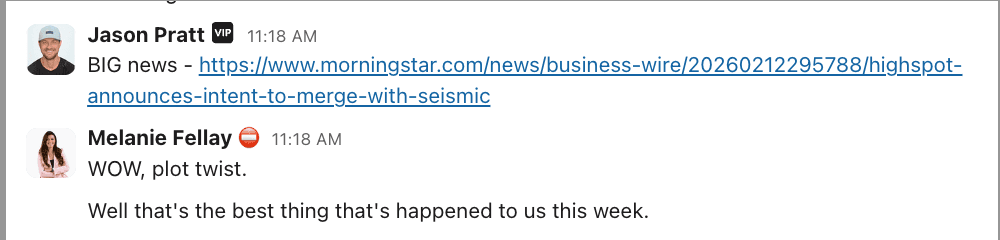
Sent the minute we found out.
“Wow, plot twist. Well, that’s the best thing that’s happened to us this week.”
That was the message I sent to our Head of Finance and COO the moment I read the news. But before I explain why I believe that, I want to start with respect.
Building two category-defining companies is incredibly hard. Seismic and Highspot have played a massive role in shaping enablement as both a function and an industry. Just look at the thousands of professionals now have “enablement” in their titles. The careers of many people we serve, including those I deeply admire and have built close friendships with, were forged by this category's existence.
And as a founder, I know first hand that that doesn’t happen by accident. It requires a level of market education, spend and conviction that few outside the founder seat can truly appreciate.
To both teams: thank you. On behalf of every founder inspired to innovate on this problem and every individual whose career has been shaped by this space, your impact has been real.
With that said, history tells us what mergers like this typically mean:
18–24 months minimum before meaningful product unification and re-architecture (the kind of work no coding agent can magically compress)
Maintaining dual architectures creates operational overhead
Roadmaps and engineering bandwidth shift from innovation to integration
Customers wait while platforms “figure it out”
So if you’re an affected customer, or a CRO or enablement leader looking to invest in rep acceleration in 2026: This is a good moment to pause.
What this signals about the category
This isn’t about feature expansion (the same way Lessonly was meant to help Seismic enter the LMS space).
It’s not a new category bet.
And it’s not a leap forward in AI.
This is pure market-driven consolidation.
We’ve seen several similar strategic combinations in the GTM tech stack over the past year, most notably the Clari and Salesloft as well as the Totango and Catalyst or even Big Tin Can and Showpad.
In this case, both companies were founded in 2011, and the last few years in GTM tech have been challenging. They’re facing a deeper reality: the innovator’s dilemma — the tension incumbents experience when protecting a large existing revenue base makes it difficult to reinvent fast enough to compete with disruptive, AI-native entrants.
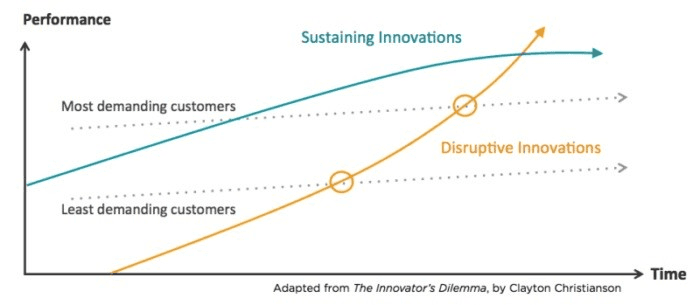
Graph depicting the innovator's dilemma when a new technology outpaces the old one as they go into maintenance mode.
This kind of consolidation typically happens when growth slows, markets mature, and meaningful innovation becomes harder inside legacy architectures. It’s especially common among companies that raised significant capital at peak valuations and are now under pressure to deliver large-scale outcomes more than a decade later. Highspot, for example, raised over $650M at a reported $2.3B valuation. At that scale, the path to IPO requires sustained growth, strong financial optics, and a defensible category position.
Neither company has moved quickly enough to outpace the rise of horizontal AI platforms (like Glean) or the surge of modern, AI-first enablement platforms (hint hint). When disruptive entrants reset buyer expectations, incumbents often consolidate as a defensive strategy. If you can’t accelerate faster than the market, you combine balance sheets, reduce competitive churn, and defend your installed base.
In this case, the combined revenue brings them closer to IPO territory (assuming they can maintain healthy metrics). At minimum, it strengthens the financial profile on paper. It mirrors what Seismic did with Savo in 2018 which was a customer consolidation strategy more than a fundamental technology leap.
The issue isn’t Seismic or Highspot as companies. It’s the architectural model that many of these legacy platforms were built on in 2011.
A portal-first approach.
Complex folder hierarchies requiring careful taxonomy management.
Optimized for long-form content that was published quarterly by marketing.
Search-and-filter-driven discovery.
And trying to layer AI on top of these legacy systems rather than embedded within them, shows.
That content management model worked when products launched quarterly, buyer journeys were relatively linear, reps had time to navigate repositories, and scaling GTM meant adding more enablement and ops headcount to manage complexity.
But that’s not how revenue teams operate in 2026.
Products evolve weekly. Buyer journeys are nonlinear and unpredictable. Reps are flooded with information. Speed of execution now matters more than repository depth.
And that’s why customers are turning to AI-first enablement platforms — not to manage more content, but to execute better in every moment that matters.
The questions any buyer in this situation should be asking
There’s often a familiar playbook for these kinds of mergers: tell a compelling “better together” story and offer attractive new deals or renewal discounts to retain as many logos as possible. But as a customer, it’s important to understand what you’re committing to.
Multi-year agreements signed during periods of structural transition can lock you into roadmap uncertainty and platform changes that are ultimately outside your control.
The first question is simple: What happens to the “other” platform?
While this is positioned as a merger, the new entity will operate as Seismic — same name, same CEO, same PE ownership. When two platforms with near-complete product overlap combine, one technology stack inevitably long-term becomes the foundation.
If the architecture you chose is deprioritized as the long-term bet, what does that mean for your implementation? Your integrations? Your admin workflows? Your reporting?
When Seismic acquired Lessonly in 2021 to enter the LMS space, they promised a seamless seller experience. More than two years later, they still required separate logins and, to this day still have very different user experiences (common with more of an integration layer in the backend vs a true rebuild or migration).
Not because of poor execution, but because true architectural unification is exponentially harder than integration.
The second question: Can you wait? Are you getting the results you need to settle for your current platform experience for the next two to three years?
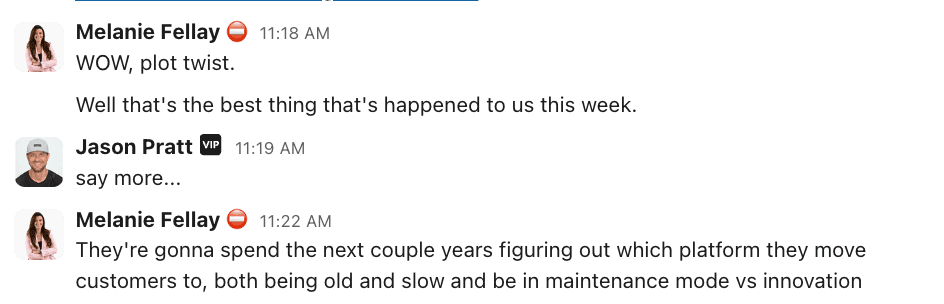
Perhaps a bit blunt.
Meaningful unification between two mature platforms doesn’t happen overnight. This merger combines two full enablement platforms with overlapping capabilities: two content models, two UX philosophies, two AI layers, and two integration ecosystems.
Realistically, that’s 18–24 months. Even in the most optimistic scenario, with AI-assisted development and world-class engineering, you’re still looking at 12 months of focused integration work.
12 months is a long time when the world isn’t slowing down.
Timeframe | What typically happens |
|---|---|
Months 0–3 (Now) |
|
Months 3–9 |
|
Months 9–18 |
|
Months 18–24+ |
|
Note: This assumes an optimistic timeline. Many integrations take longer.
Your reps are still selling in a more complex environment than ever before. Your competitors are still evolving. Your leadership team still expects more efficiency and faster growth.
AI is reshaping workflows in weeks and sales tech stacks are evolving in real time. New agents, copilots, and automation layers are being deployed across every organization. I took a vacation the first week of February and came back to everyone talking about Clawdbot (yep, Claude Cowork from January was already old news).
Every revenue leader with a number to hit wants every possible advantage for their sales team.
So if your team wasn’t fully adopting the platform before or finding what they need, it’s fair to ask: Does this merger actually fix that, or simply compound the problem?
And more importantly, how much of your execution are you willing to bet on a platform entering a multi-year integration cycle while the rest of your competitors accelerate with more AI-native systems?
Questions to help you evaluate what this merger means for your implementation
Question area | What to ask |
|---|---|
Platform Decision |
|
Innovation Velocity |
|
Contract Protection |
|
User Experience |
|
What we’re building while the market consolidates
This is why I believe this merger will ultimately be a growth driver for us as a modern enablement alternative.
We can just build.
We’re not slowing down to manage integration complexity or roadmap consolidation. We’re focused entirely on innovation.
We recently welcomed Glen Pendley, former CTO at cybersecurity leader Tenable (TENB), as our CTO to double down on that momentum. During his 15-year tenure, he helped scale the platform from a 15-person startup to a multi-billion-dollar public company. He knows what it takes to build durable, category-defining technology.
Spekit was designed as a unified platform from the start, rather than stitched together over time under a shared brand and login (see Chapter 7 in my book: Unified). Our product philosophy is that you win by delivering a single experience built on a coherent architecture and consistent UX language.
It took longer to build. It was harder to explain. And in the early days, it was harder to raise funding.
While our earliest value proposition was more DAP and tool training, in the last 24 months, the platform has transformed as we developed our full CMS capabilities, AI sales coach, deal rooms, gong integration (see videos attached) and more into a true rep acceleration platform. These investments bring to life the vision I shared in my book, Just-in-Time: The Future of Enablement in a World of AI, which has already sold over 3,000 copies.
In 2026, 100% of our R&D investment is focused on prioritizing capabilities legacy platforms simply cannot focus on during integration cycles:
GTM Content Engine
The authoritative source of GTM truth for your company—structuring your products, ICPs, stages, objections, and metrics so both humans and AI agents operate from the same, accurate foundation. See 🎥 video here.
Deep Interoperability
Seamlessly connects to your CRM, call tools, and knowledge systems—bringing all your GTM context together so Spekit powers every AI and workflow in your stack.
Agentic Sales Coach
AI that understands your rep’s learning needs leverages call transcripts, emails, CRM data, and content engagement to deliver deal-aware coaching and next-best actions directly to reps via Sidekick their assistant, in the moments that matter most.
The Default GTM Content Creation Destination
The place reps create, tailor, and deliver deal-ready content — turning context into polished deal room buyer experiences without jumping across tools. See 🎥 video here.
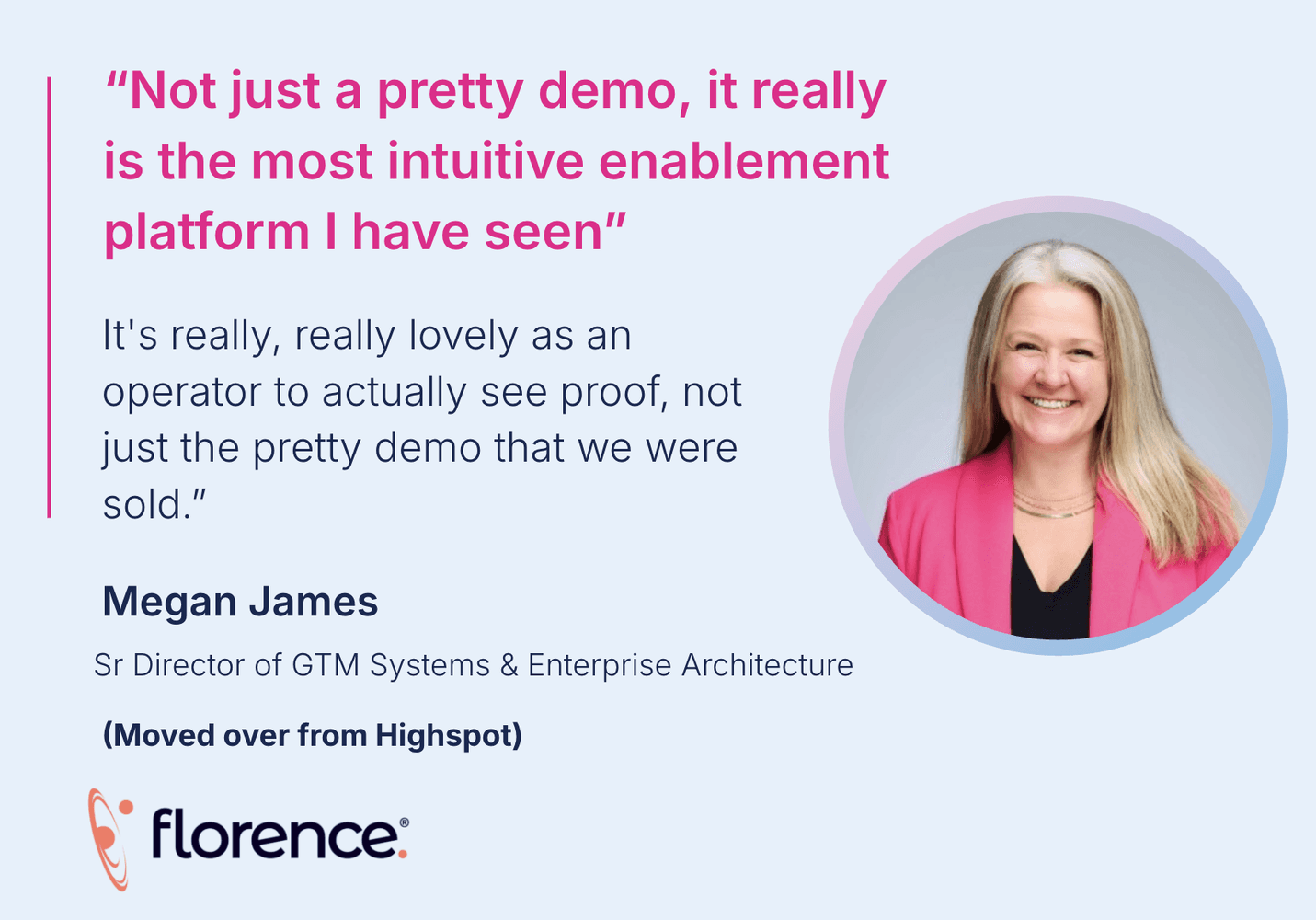
Megan who recently moved over from Highspot to Spekit at FlorenceHQ said it best:
So, an invitation…
If you’re thinking about your 2026 AI strategy and how to permanently eliminate the “garbage in, garbage out” problem in the trusted content and answers your teams rely on…
If you’re navigating this transition — whether as a Seismic customer, a Highspot customer, or someone actively evaluating platforms…
Or if you’ve been experimenting with building internal AI coaching agents — I’d genuinely love to learn what you’re seeing.
My DMs are open. So is our demo request form ;)
Let's see what else 2026 has in store...
Learn more
Discover more from the latest posts.